
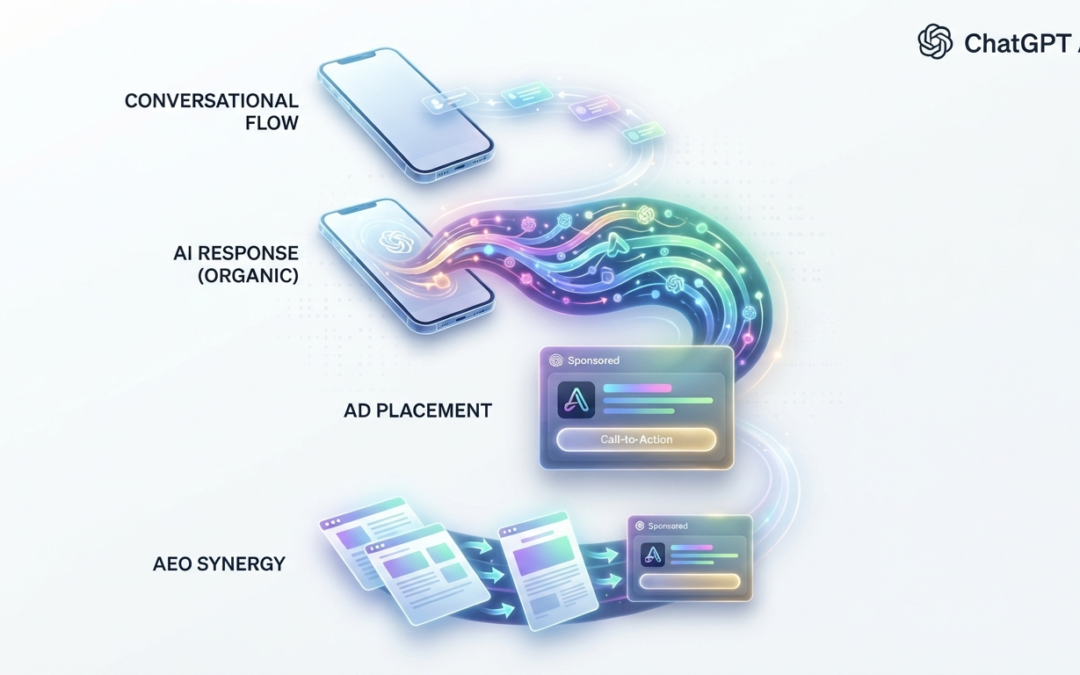
Digital advertising is undergoing a historic transformation with the launch of ChatGPT Ads, the official self-serve advertising platform developed by OpenAI [35, 100]. Following an initial testing phase in the United States, the system officially opened to Spain and over 30 European countries on August 24, 2026 [65, 107].
With a massive audience exceeding 1 billion global active users, 5.5 billion monthly visits, and a market share in AI chatbots over 77%, this new channel introduces the concept of Conversational Advertising [124, 126].
Below is a complete WordPress-optimized guide designed to provide a global and technical overview of how it works, its formats, bidding models, targeting options, and key differences compared to Google Ads and Meta Ads.
1. What is ChatGPT Ads and How Does Conversational Advertising Work?
ChatGPT Ads is OpenAI’s advertising infrastructure that enables businesses and brands to display sponsored cards within ChatGPT conversations [100, 138]. Ads appear clearly identified with a “Sponsored” label located directly beneath the response generated by the assistant [23, 40, 100].
┌─────────────────────────────────────────────────────────────────────────┐
│                       ORGANIC AI RESPONSE                               │
│  (Generated 100% independently by the language model)                    │
└─────────────────────────────────────────────────────────────────────────┘
                                     │
                                     ▼
┌─────────────────────────────────────────────────────────────────────────┐
│                        SPONSORED CARD (AD)                              │
│  Labeled as "Sponsored" • Positioned directly beneath the response      │
└─────────────────────────────────────────────────────────────────────────┘
The Principle of Answer Independence
A fundamental pillar of the platform is the principle of Answer Independence: advertisers cannot pay to alter, influence, or modify the text of organic AI responses [49, 101, 110]. The response and the advertisement are physically separated on the same screen [40].
The Paradigm Shift: From Keywords to Context Hints
Unlike traditional search engines where advertisers bid on isolated keywords, ChatGPT Ads uses Context Hints [102, 124, 128].
The average prompt or query in ChatGPT is 17 times longer than a Google search [43]. Users explain their situation or problem in their own words, allowing the algorithm to understand the customer’s true need mid-thought (midthought) and deliver a relevant ad [43, 128, 129, 130].
2. Eligible Audience: Who Sees Ads and Who Doesn’t?
To plan an effective advertising strategy, it is crucial to understand which users are exposed to advertising on the platform:
- Users who DO see ads: Exclusively adult users (18+) on free accounts (Free and Go plans) [2, 22, 41, 66, 105].
- Users who DO NOT see ads: All paid subscribers (Plus, Pro, Business, Enterprise, and Edu plans) are 100% ad-free [2, 66, 105].
- Content Safety Exclusions: OpenAI strictly prohibits advertising delivery in conversations related to politics, physical health, or mental health [41].
- Serving Frequency: OpenAI enforces a moderate ad-serving policy. Although 85% of users are eligible to see ads, fewer than 20% see an ad on any given day [50]. Additionally, users can hide ads or disable ad personalization [43, 50].
3. Ad Formats Available in ChatGPT Ads
OpenAI’s Ads Manager currently features three main ad formats [41]:
| Format | Description | Specifications & Visual Elements |
|---|---|---|
| Sponsored Answer Placement | Sponsored card located beneath the organic AI response [41, 100]. | Favicon/Logo, Brand Name, Headline (up to 50 characters), Description (up to 100 characters), and Destination URL [2, 31, 104]. |
| Shopping Carousel | Scrollable carousel of product cards for e-commerce [41]. | Product Image, Title, Price, Stock Status, and Delivery Time (Synced with Shopify and Etsy) [41, 56]. |
| Display with CTA (In Testing) | Rich format designed for visual consideration campaigns [41]. | Large image with a customizable Call to Action (CTA) button [41]. |
4. Bidding Models, Price Benchmarks, and Budgets
The Ads Manager operates via a real-time bidding (RTB) system based on a second-price auction weighted by relevance [103].
Campaign Objectives and Bidding Strategies
- CPM (Cost per Thousand Impressions): Designed for brand awareness and mass reach [3, 131].
- CPC (Cost per Click): Focused on driving qualified traffic to the landing page [3, 131]. Starting tests with a maximum CPC bid of €3.00 / $3.00 per click is recommended to ensure auction delivery [3, 30].
- oCPC (Optimized CPC): The system leverages pixel signals to optimize delivery toward users with a high conversion probability, while billing remains on a valid click basis [131, 140].
Market Price Benchmarks
- Cost per Click (CPC): Between $3.00 and $5.00 in general consumer sectors, reaching $8.00 to $15.00 in high-ticket B2B campaigns [106, 113].
- Cost per Thousand Impressions (CPM): Between $25.00 and $60.00 [106, 113].
- No Minimum Spend: The platform allows testing with low budgets (from $1–$5/day or €15/day) [1, 28, 106].
- Dynamic Daily Budget Margin: If a daily budget of €20 is set, the algorithm may spend up to €40 on a high-opportunity conversion day, self-regulating the average spend across 7-day windows [5, 6].
5. Comparison: ChatGPT Ads vs. Google Ads vs. Meta Ads
| Criterion | Google Ads | Meta Ads | ChatGPT Ads |
|---|---|---|---|
| Targeting Mechanism | Exact keywords and direct intent [102, 108]. | Interests, demographics, and behavior [108, 123]. | Context Hints [102, 108, 124]. |
| User State | Active solution-oriented search [108]. | Passive scroll / entertainment [1, 108]. | Active dialogue and midthought problem solving [43, 108, 129]. |
| Ad Placement | Search Results Page (SERP) [108]. | Feed, Stories, and Reels [108, 123]. | Card beneath AI response (Same screen) [40, 108]. |
| Maturity & Competition | Saturated market / High competition [108]. | High competition [108]. | Early stage / Low competition (First-mover opportunity) [64, 107, 108]. |
6. Essential Synergy: The Relationship Between AEO and ChatGPT Ads
To maximize Return on Ad Spend (ROAS) in ChatGPT Ads, advertisers must simultaneously execute an Answer Engine Optimization (AEO) strategy [44, 45].
AEO involves optimizing web content structure so that AI answer engines cite the brand organically in their responses [44].
                     ┌────────────────────────────────────────┐
                     │ CHATGPT ORGANIC RESPONSE               │
                     │  Cites and recommends Brand A          │
                     └────────────────────────────────────────┘
                                         │
                                         ▼ (Double visual impact)
                     ┌────────────────────────────────────────┐
                     │ BRAND A SPONSORED AD                   │
                     │  Reinforces the AI's recommendation   │
                     └────────────────────────────────────────┘
- Double Visual Impact (Share of Voice): When ChatGPT recommends a brand organically and its ad appears directly below, credibility and conversion rates compound [45].
- High Conversion Rate: AI-referred traffic converts 3 times faster than traditional search traffic [45].
- Traffic Market Share: 87.4% of all AI referral traffic globally originates from ChatGPT [45].
7. Account Structure and Step-by-Step Technical Implementation
Account Hierarchy (Tenant Hierarchy)
Account structure in OpenAI Ads Manager is organized into the following levels [137, 138]:
- Tenant: The primary organization or workspace [136, 137, 138].
- Ad Accounts: Entities tied to billing and campaign execution [137, 138].
- Campaigns, Ad Groups, and Ads: Structure equivalent to traditional Paid Media platforms [7, 138].
- Access Roles: Admin (full management), Member (ad management), and View Only [25, 137].
Technical Implementation Guide
- Sign-up & Verification: Access
ads.openai.com. Business verification typically takes 24 to 48 hours [4, 24, 56]. - Pixel & Conversions API: Copy the OpenAI JavaScript Pixel code into the website
<head>and define core events (Registration Complete,Purchase,Lead Created) [25, 26, 72, 73]. opprefClick Identifier & UTMs: OpenAI automatically appends itsopprefparameter to destination URLs for conversion attribution [133]. Adding standard UTM tags is recommended for tracking in Google Analytics 4 (utm_source=chatgpt&utm_medium=cpc&utm_campaign=campaign_name) [15, 109].- Custom Audiences Status in Europe: In the US, advertisers can upload customer databases (Custom Audiences with a minimum of 25,000 matched records) [132]. However, in Spain, the European Union, and Switzerland, Custom Audiences are currently restricted due to data protection regulations and personalized ad privacy laws [79, 80].
Frequently Asked Questions (FAQ) about ChatGPT Ads
When was ChatGPT Ads launched in Spain and Europe?
The self-serve ads manager officially launched in Spain and 30 other European markets on August 24, 2026 [65, 107].
Can brands pay to appear in ChatGPT’s organic response?
No. OpenAI strictly enforces the principle of Answer Independence: advertisers cannot pay to alter the text generated by the AI [49, 101, 110].
Do paid account users see ads?
No. Subscribers to Plus, Pro, Business, Enterprise, and Edu plans are completely ad-free [2, 66, 105].
Is there a minimum spend requirement?
No. Ads Manager has no minimum spend requirement, enabling initial testing with low budgets [39, 106, 114].