
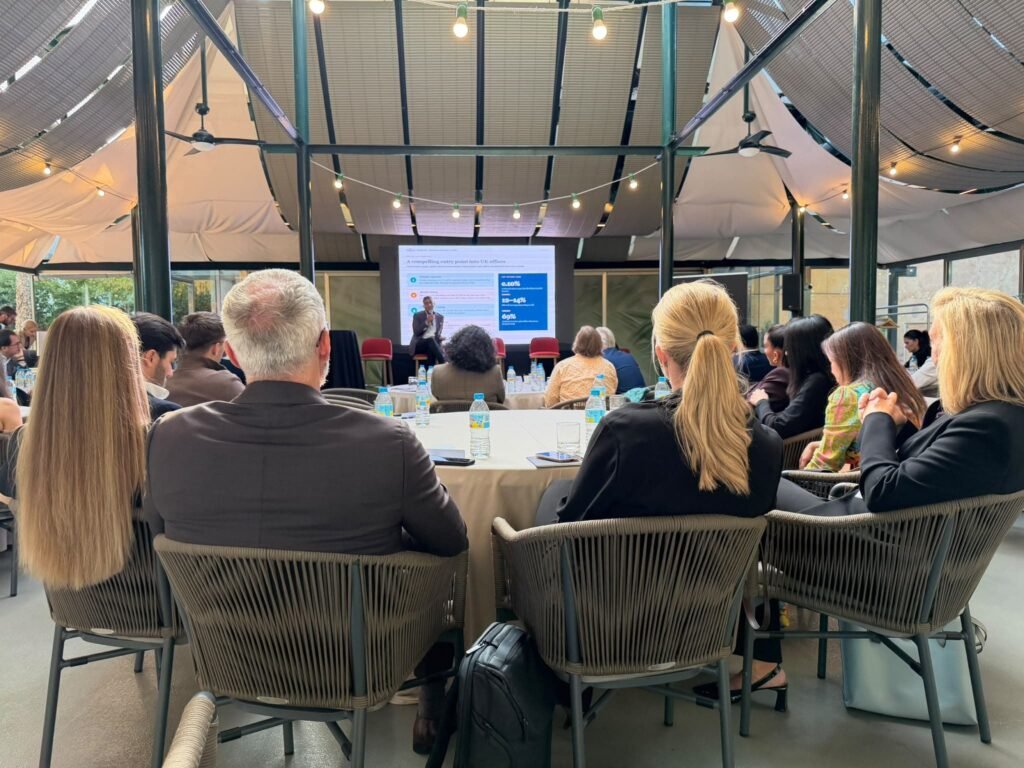
The inaugural Barcelona edition of THE LIVE concluded yesterday, presenting a refined vision of family wealth management that extends far beyond capital preservation and traditional financial yield. The event linked private investment directly to technological sovereignty, family decision-making autonomy, longevity, and long-term societal impact—aligning with the organizers’ primary thematic axes: Private Wealth, Artificial Intelligence, Longevity, and Legacy.
Editorial & Scope Note: The following analysis synthesizes the published event program, speaker profiles, and official content distributed by THE LIVE. These points reflect the conceptual framework introduced during the summit rather than audited outcomes or consensus findings among attendees.
Strategic Diversification: Funding the Future, Not Just Allocating Capital
A primary theme of the summit was the evolution of portfolio diversification. Rather than merely distributing assets across traditional investment classes, modern wealth preservation requires strategic exposure to macroeconomic and technological shifts—specifically across artificial intelligence, longevity, and advanced healthcare, alongside direct investment and co-investment structures.
Heterogeneous AI Exposure and Market Access
The organizer’s content introduced a critical distinction regarding AI investment: artificial intelligence cannot be treated as a monolithic asset class.
- Layered Risk Profiles: Investing in physical or computational AI infrastructure involves completely different risk parameters than backing early-stage technology startups.
- Ecosystem and Access: Capital alone no longer guarantees access to top-tier transactions (deal flow). Direct relationships with founders, specialized operators, and institutional co-investors represent a vital prerequisite for entry.
Ultimately, navigating next-generation opportunities demands rigorous sector-specific discernment and established networks rather than speculative trend-following.
Sovereign Artificial Intelligence: From Data Security to Information Governance
One of the most distinctive aspects of THE LIVE’s thesis is its framing of Artificial Intelligence. AI was presented not merely as an investment vertical or an operational efficiency tool for family offices, but as an existential matter of information sovereignty.
The organization highlighted that storing sensitive data in a specific physical or cloud location does not guarantee operational control—particularly when underlying software and hardware infrastructures belong to third parties.
Air-Gapped AI and Family Knowledge Control
Under this paradigm, the core question shifts from “Is our data protected?” to “Under what legal and technical conditions can our information be utilized, and what control does the family retain?”
The program specifically addressed Sovereign AI and air-gapped systems (environments physically and logically isolated from external networks) as essential mechanisms for maintaining confidentiality. The goal is enabling family offices to leverage advanced LLMs and analytical tools without forfeiting control over proprietary knowledge and sensitive family data.
Strategic Philanthropy and Legacy: Aligning Capital with Measurable Impact
THE LIVE explicitly integrated legacy, philanthropy at scale, and impact investing into the core conversation of private wealth. Rather than treating philanthropic endeavors as isolated side projects, the summit examined how impact can be woven directly into overarching deployment strategies and generational transfers.
Concept Models Presented at the Event
- Rosser Goodman: Examined the intersection of private financing, philanthropy, and media production, highlighting how film financing can bridge wealth management, storytelling, and cultural legacy.
- Sadaqah Garden Property Fund: Presented a commercial real estate initiative designed to align financial yield with humanitarian and community impact. (Note: This represents a conceptual model introduced by a participant, not an audited impact outcome).
These examples illustrate a growing effort to harmonize financial performance with positive social contribution, reflecting how family values are increasingly embedded into capital allocation.
The Human Factor and Longevity: Preserving Autonomy in an Algorithmic Era
Technological advancement was consistently evaluated alongside human leadership, discernment, and personal agency. In an environment where AI increasingly influences analytical processes and decision-making, human oversight remains paramount.
This connection was articulated by speaker Grace Balev in her session, “Sovereign AI Begins with Sovereign Humans,” which emphasized that technological sovereignty relies fundamentally on independent human discernment and governance.
Extended Horizons in Family Planning
The integration of longevity science introduces a structural shift in wealth management. As active lifespans extend, traditional timelines for wealth transition, liquidity events, family governance, and philanthropic initiatives must adapt. Capital is no longer structured purely for exponential growth, but to sustainably support living generations, ongoing responsibilities, and long-term ventures over extended timeframes.
A New Framework for the Modern Family Office
THE LIVE Barcelona demonstrated a broad evolution in the family office dialogue: moving from how to preserve and grow capital to how to deploy it with autonomy, discernment, and purpose.
While core investment remains central, the strategic questions have expanded: To what end is capital deployed, who controls the underlying intelligence, and what lasting impact will remain? 
Subscribers only
This story is for subscribers
Subscribe to VIP Today Magazine to read this article and every story in full. It is free, and you only do it once.
Subscribe, it’s free